


🧀 Sentinel Colorado's ownership change: A Green Bay Packers model?
The news behind the news in Colorado this week

Earlier this month, the weekly Sentinel Colorado newspaper in Aurora announced it would change ownership in a way that seeks to keep it in local hands.
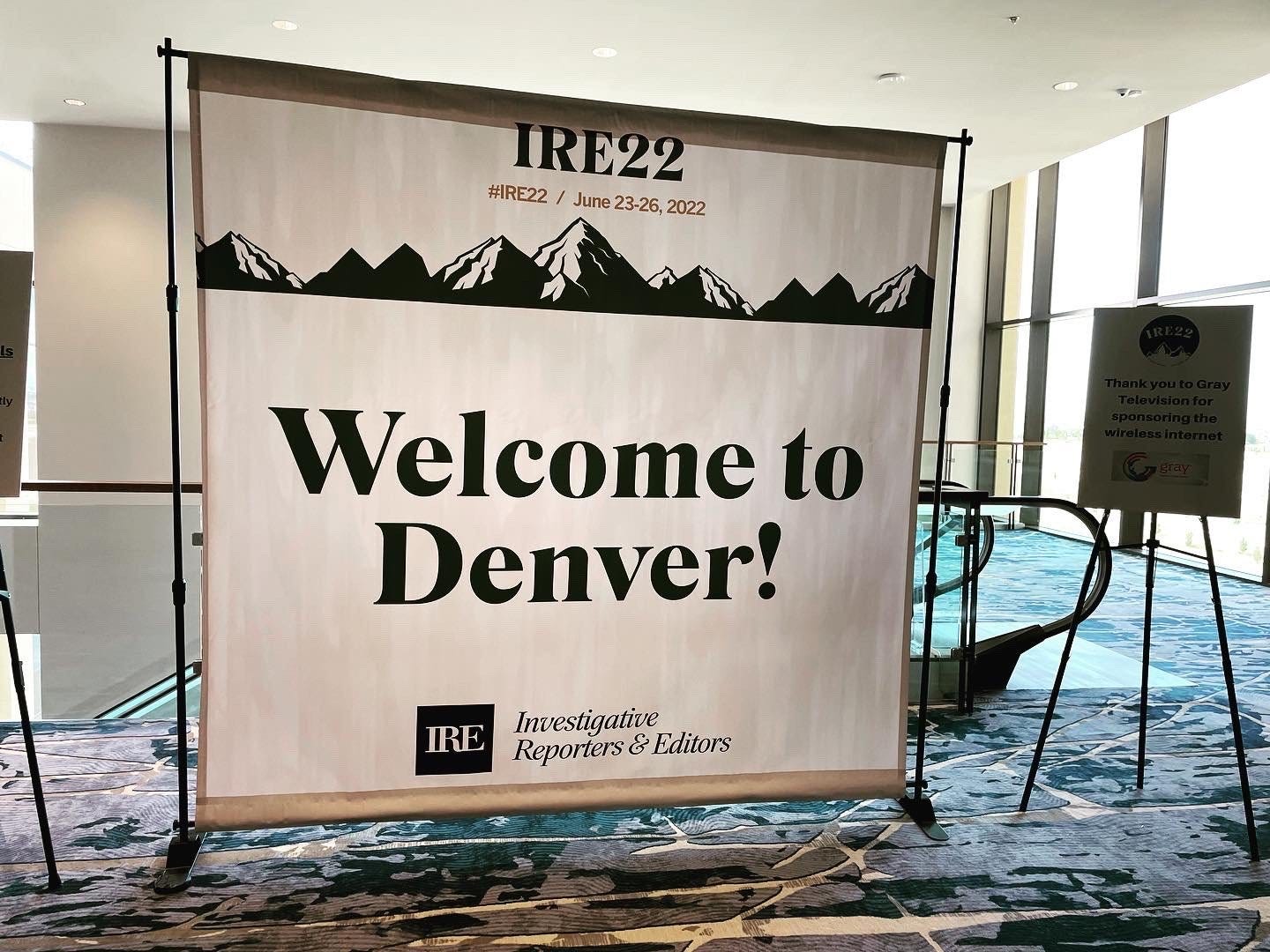
But potentially just how many local hands was something that emerged during a panel at this year’s Investigative Reporters & Editors conference, known as IRE22, held June 23-26 at the Gaylord Rockies hotel in Aurora.
The panel was titled “Collaborating beyond editorial: How media can innovate business models better together.” Laura Frank, executive director of the Colorado News Collaborative, led it. During part of the discussion, she spoke about how the recent ownership transfer of the Sentinel Colorado came together.
When the pandemic hit, Frank said, the paper lost half of its advertising. Meanwhile, James Gold, the paper’s owner, had started a new company and he wanted to focus more on that. He suggested to Frank that perhaps COLab might be interested in taking over the paper. But while COLab is a 2-year-old nonprofit aimed at bolstering local news on multiple fronts, it’s “not set up to take a newspaper or to run a newspaper,” Frank said. “Thats not how we’re staffed; that’s not what we decided to do.”
So COLab declined, but saw an opportunity. Joaquin Alvarado of Oakland, California, who runs a consultancy called Studiotobe, had worked on projects aimed at keeping local news ownership close to the communities they serve. He and COLab got in touch and Alvarado created an LLC, “basically a temporary holding company to receive the Sentinel,” Frank said. The paper will stay there while they look to see how members of the Aurora community could one day wind up owning the paper.
One particular model of community ownership they’re contemplating is that of the Green Bay Packers in Wisconsin. There, fans collectively own the NFL football team through public stock sales. Frank said those working on the Sentinel transition are wondering if readers of the paper might similarly be able to collectively own the Sentinel.
“This is something that is an idea for an experiment and we’re trying to figure out how it would work, legally, technically,” Frank said, adding that it could potentially offer stable funding for the paper as a community asset.
“This is not a rich place by any means but people are incredibly generous and dedicated,” Sentinel Editor Dave Perry recently told Brier Dudley of the The Seattle Times for a column about the Sentinel’s Green Bay-inspired idea.
From the Seattle Times piece:
The Sentinel’s new approach is bold at a time when newspaper production costs are rising and the economy is likely to make it harder to generate support from individuals and charitable organizations. Yet there’s something in the thin, mountain air that inspires entrepreneurial journalists. In recent years the Denver area emerged as a hub for experimenting with new approaches to saving local news coverage.
Elsewhere in the column, Dudley reported that Alvarado had “put up between $50,000 and $100,000 to continue running operations and paying the 11 employees, including a newsroom of seven.”
Just how serious is this Packers-esque endeavor? During her IRE panel last week, Frank said COLab is planning to attend the football team’s July stockholders meeting in Green Bay to learn more about its funding model.
Packers fans — known as cheese heads — are notoriously dedicated. Asked by an audience member whether a newspaper might be able to generate as much enthusiasm, Frank said the community knows the Sentinel is an important local institution and that there is enthusiasm around it. But, “do we think people will be wearing cheese on their heads?” Frank said. “No.”
During her talk at IRE22, Frank stressed that all of this is in testing mode and it might wind up looking different when it all shakes out. Asked by an audience member about going the nonprofit route, Frank said it’s still possible the paper could do that. But “that’s less for COLab to decide and more for community [to decide],” she said. (Frank also noted the sometimes fickle winds of philanthropic giving.)
She left the national audience with this: Colorado is a unique place for such an experiment. “We have an existing ecosystem that’s really thinking about the future, and pretty cutting edge,” she said. Read more about what else is going on in that ecosystem here.
🌿 This week’s newsletter is proudly supported in part by Grasslands, Denver’s Indigenous-owned PR, marketing, and ad agency that is thankful for the tireless work reporters do to bring our communities the stories that matter. Founded by veteran Denver Post journalist Ricardo Baca, Grasslands — the recipient of a 2020 Denver Business Journal Small Business Award — is a Journalism-Minded Agency™ working with brands in highly regulated industries including cannabis, technology, and real estate. Operating from its new offices in Denver’s Art District on Santa Fe, the firm’s 20-person team of communications professionals is focused on a single mission: “We tell stories, build brands and amplify value.” Email hello@mygrasslands.com to see how Grasslands can supercharge your brand’s marketing program (and read some of our cannabis journalist Q&As here). 🌿

‘Alpha’ and ‘The Holly’ win Colorado Book Awards
Speaking of the recent IRE conference, two of its Colorado-based presenters this year, David Philipps and Julian Rubinstein, won Colorado Book Awards on June 25.
Philipps, who is a national reporter for The New York Times and who lives in Colorado Springs, won in the biography category for his book “Alpha: Eddie Gallagher and the War for the Soul of the Navy SEALs.”
Rubinstein won in the nonfiction category for his book “The Holly: Five Bullets, One Gun, and the Struggle to Save an American Neighborhood.”
The Denver Gazette, which has reported multiple times on the newsworthy contents of The Holly and local reaction to it — along with the author’s recently debuted documentary about the same subject — carried a write-up about the honor.
From the story, which called the work a “high-profile book”:
“The Holly” tells the sweeping and unsparing story of the former Holly Square shopping center as a hub of a small part of Northeast Park Hill spanning the eras of the Black Panthers to Black Lives Matter. It is, in its way, Denver’s very own version of “Bonfire of the Vanities,” combining elements of economic oppression and gentrification against institutional power, racism, police and government corruption, and a reformed anti-hero who is now running to be the next mayor of Denver. …
Other winners include Pulitzer Prize-winning reporter David Philipps’ “Alpha: Eddie Gallagher and the War for the Soul of the Navy Seals,” an epic account of Alpha platoon, the startling accusations against their chief and the courtroom battle that exposed the dark underbelly of America’s special forces.
A day prior to the book awards, Philipps presented at the IRE conference on a panel with his colleagues for their impactful Pulitzer Prize-winning series on U.S. airstrikes gone wrong in Iraq, Syria, and Afghanistan. (I was humbled to moderate it.) Rubinstein had presented just hours before the awards ceremony on a panel about confidential sources.
‘No apologies’: A Denver Post sportswriter and the Stanley Cup
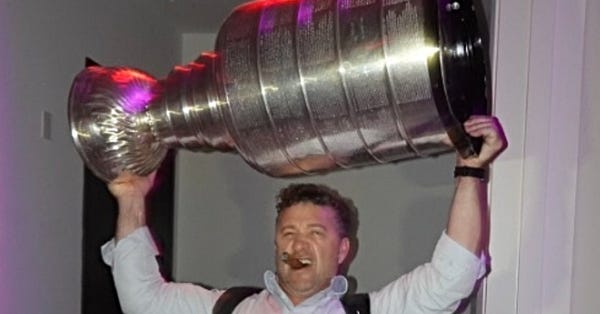
Some sports and media observers this week wondered if Denver Post hockey writer Mike Chambers might take a visit to the penalty box after he posted photos on social media of him hoisting the Stanley Cup over his head with a cigar in his mouth following the Colorado Avalanche team winning the NHL championship.

Coverage of it made the rounds, and talkers yakked about it on the radio.
Here’s Yahoo!Sports writer Olivier Neven on the issue:
Many fans and fellow media members took exception to Chambers’ celebrations, reminding the reporter of the impartiality and objectivity that the press are traditionally expected to adhere to.
Vic Lombardi, an Altitude TV reporter and host, had a different take:


For what it’s worth, a Denver TV news personality was reporting on air during last Friday’s game while wearing an Avs jersey. (It made for about 30 seconds of commentary among a handful of viewers at The Denver Press Club.) Journalists covering sports might treat such coverage differently than they would, say, public affairs reporting. Or, in some cases, maybe just the same.
Westword’s Michael Roberts rounded up portions of a debate some had about the extent to which the journalist-cup-hoist was an appropriate thing to do, including this intrigue: “There’s a longstanding tradition that only triumphant players and other team personnel have the right to lift the Cup as Chambers did. The trophy is viewed as sacred by hockey purists, and superstitions around it abound.”
Better, though, was that Roberts got the backstory from Chambers about how the scenario went down. From Westword:
“I walked near the Cup with no intention of touching it and was approached by Gabe Landeskog,” Chambers notes. “He bear-hugged me for about a minute, with mostly him talking. He thanked me for my professionalism and class in my coverage. It was mutual professional respect. Gabe and I go back to 2011, when he joined the Avs at age eighteen. We’ve had a long history through the ups and downs of the team’s play, of my coverage. To that end, Gabe wanted to take a picture with me and the Cup. I obliged. He held one side, I held the other. I let go and he then handed it to me and said something like ‘Hold it high.’” Chambers adds: “I was honoring Gabe’s wishes. I would not have touched the thing if he didn’t ask me to.”
Roberts wrote that Chambers “offers no apologies about his decision — and the photo remains proudly displayed on his Twitter feed.”
Aspen Times follow-up, week … four is it now?
In a June 17 edition of this newsletter, fired Aspen Times Editor Andrew Travers made a prediction. The interest and negative attention that had already surrounded his former newspaper for several days would not be a “one-day or a one-week story,” he said.
So far that has checked out.
This week, as controversy continued to swirl around the paper, nearly 20 former and current elected officials in the Aspen area signed a letter to Ogden Newspapers of West Virginia that essentially threatened the new owners of The Aspen Times.
The newspaper’s turmoil includes a billionaire developer’s lawsuit (and later settlement), the paper’s editor quitting while citing the “vibe” under new ownership, the town’s mayor accusing the paper of suppressing news coverage, the interim editor “strenuously” objecting to management decisions, and the paper firing Travers for publishing a guest column by a local named Roger Marolt that was critical of how the paper has handled some of the above developments.
On June 18, The Denver Post’s Sam Tabachnik published a story headlined “This Colorado newspaper settled a billionaire’s defamation lawsuit. Then things really got ugly.” The story recapped the recent unfortunate events. (Notably, The Aspen Times re-published the story in print. It came with this copy editor’s note: “The decision to publish this Denver Post story was entirely at the discretion of production editor Benjamin Welch.”)
Three days later, Marolt, the columnist whose critical column had disappeared from the Aspen Times website leading to more negative coverage of the paper, on June 21 published a column in the rival Aspen Daily News. It carried this headline: “If you are reading this in the Aspen Daily News, I went too far.”
From the column:
This was supposed to be my last column for The Aspen Times, but now is my first for the Aspen Daily News. It depended on how delicately I crafted this piece; if I stayed between the company lines in giving the reason for my departure, the new owners of The Aspen Times might have allowed me to say goodbye in their paper last Friday. Alas, it’s three spikes and I’m out.
(In newspaper-speak a writer having a column or news story “spiked” means an editor or someone higher up stopped it from publishing — usually for reasons contrary to the values of good journalism.)
As that played out, three days later, Aspen Times Publisher Allison Pattillo published the letter that public officials had written to her boss.
Included in the item was a note of her own saying that while she found it “encouraging to see their expressed support for the importance of vigorous, independent community journalism, which this newspaper has provided to Aspen for more than 140 years,” she felt it is “frankly shocking to see elected officials so brazenly threaten to use their positions of power to control a community newspaper.”
Here’s part of the letter, which included the signatures of five sitting council members from three towns, five current Pitkin County commissioners, and the mayor of Aspen:
Our faith in Ogden Newspapers is shattered and we are individually considering separate reactions as a result, including: directing our individual organizations to pull advertisements and notices from the paper; encouraging local businesses to do the same; refusing interviews with reporters at the Aspen Times; or calling for a community boycott of the paper.
To reinstate our trust in the Aspen Times, we would like to see clear action from Ogden Newspapers such as the following: reinstatement of Andrew Travers as the Editor in Chief; re-publication of Marolt’s June 10 column; a joint statement from Travers, Allison Pattillo, the publisher of the Times, and yourself, detailing the editorial freedom and standards of transparency that will be carried forward; and, public clarity about the settlement that was reached by Doronin’s lawsuit.
So to recap: local government officials believe in editorial freedom so much that they’d like to dictate the newspaper issue a statement about (drumroll) its editorial freedom.
In a letter to the editor of the Times, which the paper published June 27, a reader named Neil Siegel wrote that while he was “dismayed by the turmoil at the paper,” he felt “that 18 past or present local elected officials, either by perceived collective power or by privilege of title would have the audacity to divine requirements for content in The Aspen Times is both odious and repugnant.”
About 1,500 miles away, in Wheeling, West Virginia, at least one publication is wondering what’s going on with the newspaper company headquartered in its hometown.
“What’s happening at Ogden Newspapers?” asked The Wheeling Alternative, a blog written by someone who describes themself as a retired educator with an interest in media, and who recapped the events in Aspen. “I’ll try to keep up,” the author wrote.
Denver news anchor: How does an insurrection become a ‘both-sides political issue’?
Kyle Clark, the nightly news anchor for Denver’s compelling KUSA 9News show “Next,” might have been away on vacation last week, but he was still using his social media to slay online trolls, raise money for local nonprofits, and recruit for a producer job on his doing-the-local-TV-news-differently show ‘Next’.
Before he took off, though, former Denver prosecutor Craig Silverman, who had recently interviewed Clark on his podcast, penned a send-up to the newsman in The Colorado Sun.
Some nuggets from the column (emphasis mine):
“Clark is gifted, but he also gifts back. His weekly Word of Thanks from Next micro-giving campaign has raised over $9 million for diverse Colorado nonprofits. He contributes his own $250 each Wednesday.”
“When asked if political commentating was worth it, Clark explained, ‘We constantly have to reassess. We would be foolish not to do that, but the work is that important. And the issue is that important in terms of, what’s the power that extremists hold in our society? And to what extent does that endanger the lives of our neighbors? And how does that change the way that we function as a society?’”
“…doing that work, inherent in it these days, are threats of violence against journalists, against their family members, against their spouses, threats of violence against their children, their coworkers, but there have to be some people who are willing to stand up and say, ‘I won’t be driven out of this space; I won’t be silenced by your threats.’”
About Jan. 6, Clark said, “The thing that I struggle with the most is trying to understand how a violent attempted coup and insurrection at the U.S. Capitol becomes a both-sides political issue as opposed to an issue that nearly every man woman and child in America goes, I don’t care about politics, that’s wrong. That’s a threat to America and we must stand united against it.”
Read the whole column at the link above.
Boulder’s newspaper got a new opinion editor
Opinions. Everybody has one. But the Daily Camera newspaper in Boulder has been struggling with a consistent voice for its opinions for the past few years.
The paper unceremoniously fired its opinion editor Dave Krieger in 2018 after he criticized the paper’s cost-cutting hedge-fund owner in a personal blog post. Two years later, the opinion editor who replaced him, Quentin Young, left the Camera to launch Colorado Newsline. Julie Marshall replaced Young in 2021 — and then left the paper a year later.
This week, the Camera announced Gary Garrison as the latest who will be managing the opinion section there. He is “returning to the Boulder Valley after several years outside of Colorado and the country,” most recently in Spain where he taught English. “A reader since 2011, Garrison jumped at the chance to work at his hometown newspaper,” the Camera reported.
From the write-up:
Garrison said he hopes to build the Camera’s opinion pages into a place of inclusive civility in a time where Americans appear more divided than ever along political lines, and when newspaper opinion sections have lost relevance in the age of social media dominating the public square.
Learn more about the paper’s new opinion page editor at the link above.
More Colorado media odds & ends
💰 Colorado Media Project, which underwrites this newsletter, is “starting a fund to help Colorado journalists pay for public records that enhance reporting on social, economic, racial and other inequities,” the Colorado Freedom of Information Coalition’s Jeff Roberts reports. “Seeded by The Colorado Trust, the new ‘watchdog fund’ will reimburse applicants for money spent on records already obtained and help them secure records for ongoing stories — up to $1,000 per request.”
👀 Benn Farrell, a freelancer from Monument, Colorado, says he got conned after receiving “a news tip from a young journalist working in Salt Lake City who wanted to tell us the story of his grandfather.” But it turns out the grandfather doesn’t exist? “I’m sorry I wasted your time,” Ferrell says the person who made the pitch texted him before the story ran in a local Colorado newspaper.
🎙Rocky Mountain Community Radio announced it hired Maeve Conran as the network’s “first managing editor, a new position that will be housed at Aspen Public Radio,” KGNU reported. “Conran will report to Aspen Public Radio news director Brent Gardner-Smith. She begins her new role on July 7.”
🎤 Jason Van Tatenhove, who runs the Colorado Switchblade local news Substack in Estes Park, said, “I will be testifying at the January 6th Committee Hearings in Washington DC, giving a historical overview of the Oath Keepers and violent militias.” (His June post says “this month” but he told me it looks like his testimony has been pushed into mid-July-ish. He expects it will be during prime time.)
📍A new Medill Local News Initiative report documents the state of U.S. local news post-pandemic “focusing on the health of both local newspapers and digital sites.” (On social media, I noted how hard quantifying local news outlets can be.)
📡 Erin O'Toole is leaving KUNC for City Cast Denver. “I’m beyond thrilled to announce that I'm now an audio producer,” she said.
☀️ The Colorado Sun is hiring a “product producer” the public benefit corporation will pay between $65,000 and $75,000. “This role will contribute to daily news coverage while working to develop and improve internal and audience-facing products,” the news outlet stated on social media.
🆕 The Denver Business Journal “has named Nikki Wentling as technology reporter.” Wentling “comes to the DBJ from a position as national reporter with Stars and Stripes, a U.S. military news outlet,” the paper reported.
🗳 A big pre-election Washington Post story by Rosalind S. Helderman headlined “With violent rhetoric and election denial, podcaster becomes GOP force” relied on reporting from the progressive nonprofit Colorado Times Recorder more than any other local outlet. It underscored once again the influence of new online media, including ones with murky funding models.
🦅 John Waters will become the new editor of The Crestone Eagle in Saguache County as it transitions into a nonprofit. Waters previously was news editor at the Valley Courier in Alamosa and recently sold a newspaper he founded in Texas called The Big Bend Gazette.
🤔 “I do not subscribe to ANY newspapers nor would I choose to read them online,” says local person who also complains of “just now being informed” of an ordinance from 2018. Local journalist publicly wonders: “You don’t think those two things might be connected, ma’am?”
I’m Corey Hutchins, interim director of Colorado College’s Journalism Institute. For nearly a decade I’ve reported on the U.S. local media scene for Columbia Journalism Review, and I’ve been a journalist for longer at multiple news organizations. The Colorado Media Project, where I write case studies, is underwriting this newsletter, and my “Inside the News” column appears at COLab, both of which I sometimes write about here. (If you would like to underwrite this newsletter like CMP and Grasslands, hit me up.) Follow me on Twitter, reply or subscribe to this weekly newsletter here, or e-mail me at CoreyHutchins [at] gmail [dot] com.