

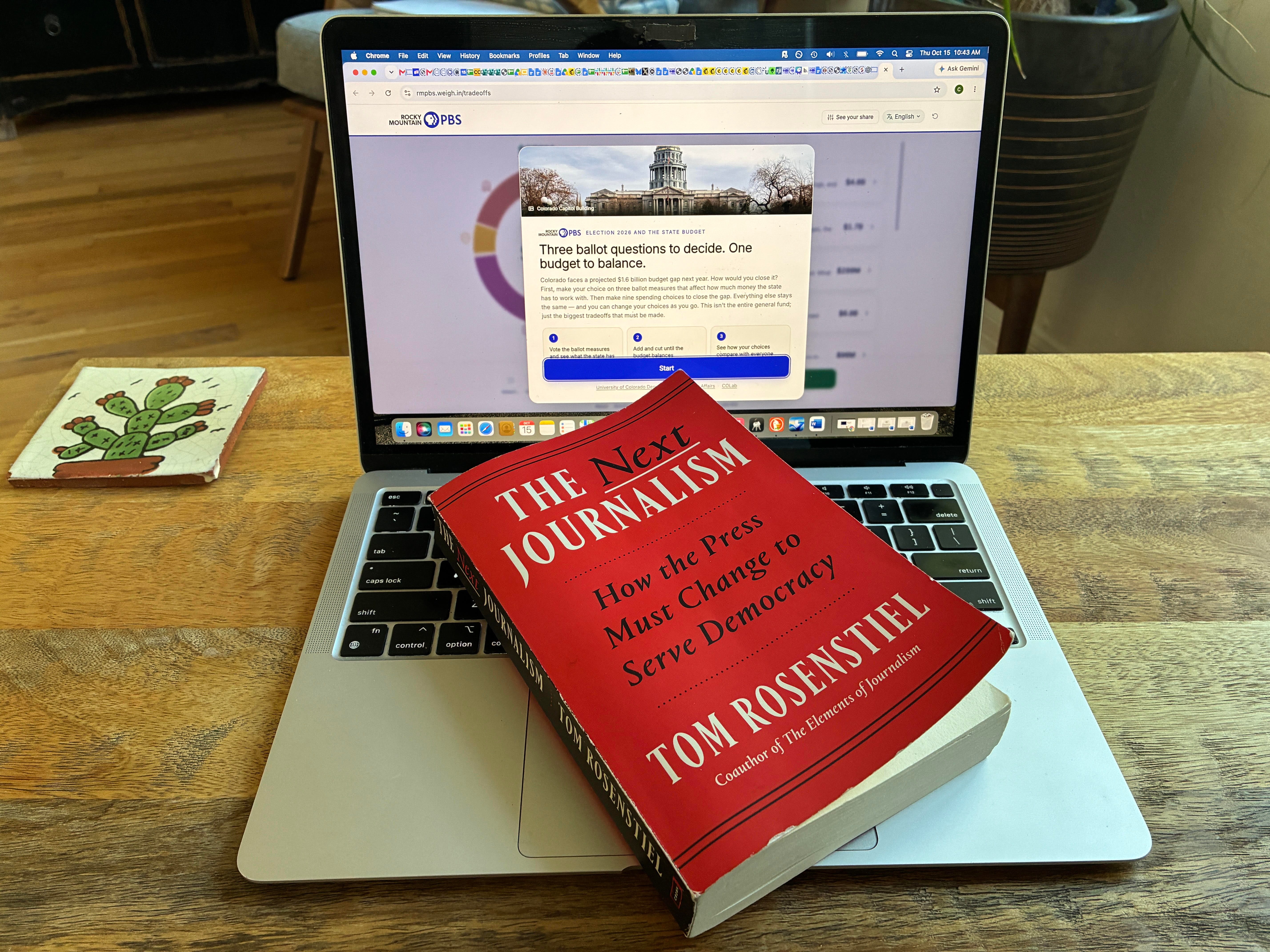
A new book by Tom Rosenstiel, “The Next Journalism,” offers 10 ways in which the press “must change to serve democracy.”
A co-author of the journalism educator’s ur-text “The Elements of Journalism,” Rosenstiel is a rightfully influential figure in the field and one of the discipline’s most thoughtful thinkers.
Since his new book came out in August, I’ve been urging any news editor I come across to read it.
In practicing the next journalism, the author writes that journalists “must begin to place the public at the center of their work, not treat them as passive bystanders to it.” To do this, he says, “they must judge their work by a new standard — the value it provides the public, not the attention it generates.”
Journalists, he implores, “must embrace the idea that their profession is a service, the fundamental purpose of which is to help people improve their lives and their communities. That requires moving beyond the limited idea that journalism is storytelling or even merely informing.”
These brief excerpts hardly do the book’s core concepts justice. But I’ve been thinking of these specific aspects of it while evaluating news coverage of our state’s upcoming election and one project’s role in it.
This cycle, the nonprofit Colorado News Collaborative journalism support organization, along with CU Denver’s School of Public Affairs and the public benefit corporation Weigh In, is offering local news outlets a digital tool called “Colorado Tradeoffs.” Had these folks implemented this four years ago, the initiative might have made for a case study in “The Next Journalism.”
The tool, available in English and Spanish, helps voters better understand some of the major initiative questions on their ballot. Voters use a simulation to see how their votes would impact the state budget and can input how they might vote and then allocate funding for education, prisons, healthcare, housing, and rainy day funds to balance the budget based on those votes.
Colorado lawmakers are constitutionally required to pass a balanced budget every year. The state faces a $1.6 billion budget shortfall.
About 30 Colorado newsrooms are currently using the Colorado Tradeoffs tool on their websites.
This comes from a pitch to newsrooms for it in publicity materials:
Colorado Tradeoffs was designed to support the unique role of the media to create informed citizens who have the understanding required to make informed decisions. It uses online simulation technology to show residents the consequences of their decisions so they don’t have to rely on campaign slogans or un-engaging official analysis.
It is also designed to build stronger connections with your readers, viewers, and listeners. The simulation can be embedded on your website and election coverage and customized with your logo and colors. You will have access to a comprehensive report on how your audience responded including comparing with the rest of the state. The report is a new kind of data for your reporting. It shows what your audience actually chose when the money had to add up.
Each election cycle, when ballots start hitting mailboxes about a month before Election Day, traffic spikes to Colorado news websites as voters crack open their laptops, unlock their phone screens, and tap out questions into their favorite search engine, chatbot, or AI tool.
Laura Frank, who runs COLab, said in an interview this week that what she and her partners have learned so far is that when people have the opportunity to dig into the details of what their vote actually means they are sometimes changing their minds.
“Up to 10 to 15 percent of people actually say in the beginning ‘I would vote one way or the other on these three big ballot measures,’ but by the end, once they’ve had a chance to try to balance the budget and decide ‘Well, what would I cut?’ or ‘what would I add?’ they change their minds on how they would vote,” she said.
She added that people using the tools are changing their minds back and forth.
“It’s helping them think through their choices and really understand beyond just talking points what their vote will mean,” she said.
No matter where someone is on the political spectrum, she said, they can balance the budget while keeping their own values intact.
So far, Frank said, newsrooms that she has heard from that are housing the tool on their websites are enthused by the engagement.
Vince Bzdek, the outgoing executive editor of Colorado Politics and the Denver and Colorado Springs Gazette, has endorsed the tool as a chance for voters to “do a little do-it-yourself democracy again.” He has urged readers of his media outlets to give it a whirl.
From his column:
Why might these tools be better than reading party platforms, candidate bios or sifting through 60-page election guides yourself?
Well, for one thing, ChatGPT and other AI chatbots have changed the way we access information and now most people are very comfortable interacting with data in a give-and-take kind of way, asking smart questions of it. These tools reflect that shift in how we learn things.
To be clear, not everyone is singing its praises.
Republican State Sen. Barbara Kirkmeyer, who sits on the State Budget Committee, told journalist Sandra Fish that she doesn’t think it “necessarily captures the nuances of what goes on in our budget or how things actually work within the budget” and “doesn’t really give the full picture.”
Colorado Tradeoffs is the brainchild of Christopher Adams, a lecturer at CU Denver who founded Weigh In and worked with Frank and Paul Teske, the former dean of the CU Denver School of Public Affairs, on how to implement it.
In “The Next Journalism,” Rosenstiel writes that as the economic model for journalism shifts from monetizing the attention of audiences for advertising to “creating value for people so that they will pay for news,” the source of engagement “increasingly must tilt towards usefulness.”
In Colorado, “there’s a hunger, a desire, for quality information about civic life, civic decisions,” Frank said about the impetus for creating the tool for newsrooms. She said COLab increasingly wants to help make that happen.
She added that she believed news organizations “need to earn their place as the public square,” and that Colorado Tradeoffs and other tools “helps reinforce that.”
Frank hasn’t yet read “The Next Journalism,” but she needn’t read it backwards. The last chapter is titled “The Public Square: Creating Journalism for All.”
I caught up with Rosenstiel, the author of the book, over the phone this week to talk briefly about the Colorado Tradeoffs tool, and he checked it out online.
In a follow-up email, he called it a “remarkable model for how news organizations, in collaboration with other local institutions, can make journalism more useful for Americans.” He said he thought it was “intuitive, clean, informative,” and anyone who uses it gets an “indisputable lesson” in public policy budget choices.
“That may sound exotic,” he said, but it is something every Coloradan is asked to do. “This is a tool that makes us better voters and will make for more coherent policy making for those who use it.”
➡️ This newsletter is proudly sponsored by The Colorado Health Foundation. As a proud funder of Colorado Media Project, the home of Press Forward Colorado, the CHF understands that healthy communities need a healthy news ecosystem.
This year, The Colorado Health Foundation is working to combat disinformation and misinformation, and helping nonprofits build media literacy.
🗳 As part of The Colorado Health Foundation’s commitment to listening to and amplifying the voices and interests of communities across Colorado, we’re partnering with the Colorado Sun and Entravision to host a series of candidate conversations. These events will give Coloradans an opportunity to hear directly from candidates about the pressing issues facing our state.
The Colorado News Collaborative called our annual Pulse Poll a “trove of information useful to reporters.” Get in touch to see how the data might be useful for any stories you are pursuing — or to learn about potential story ideas. ⬅️

CSU professor and students water a suburban news desert in Northern Colorado
A university instructor has launched a new publication, written and reported by her students, that aims to fill a gap in a suburban news desert in northern Colorado.
Last month, Jenny Fischer at Colorado State University in Fort Collins and her students started Wellington Bulletin, a weekly Substack newsletter covering a community of about 12,000, about 20 minutes north of campus.
Wellington is not the kind of area — think rural — that might immediately come to mind when considering a place without a dedicated local news organization.
But Wellington is a “news desert,” Fischer said over the phone this week. “And by definition, it flies in the face of what a typical news desert is.”
The growing town is comparably more affluent and educated, she said, and it’s close to a city that has a local media outlet. While it gets some overlapping coverage, it isn’t enough.
Fischer wanted to see what her journalism program could do about that.
Enter Wellington Bulletin, which is the work product of 12 students in a CSU class called “Deliberative Journalism.” Students come up with story ideas and report them out. Fischer, the class instructor, edits the copy after a round of student editing.
They chose Substack as a platform because of how user-friendly it is, she said.
The development is another example of a news-academic partnership in which a higher-ed journalism program runs a standalone community news source out of a classroom with students providing the content and an instructor acting as an editor.
And it further underscores the various ways in which colleges and universities are supporting their students and their state’s local media ecosystems at the same time.
Recent news stories in Wellington Bulletin include a local event to help food insecurity in the area, how the Fort Collins Habitat for Humanity is returning to Wellington, a local high school football game recap, and an update about local water infrastructure upgrades.
The newsletter tends to be heavier on sports at the beginning of the week and heavier on news towards the end.
“We’re running it like a newsroom as close as we can get,” Fischer said about the project.
A version of this item appeared in the Community Newswire newsletter for the Center for Community News on which Fischer collaborated. Learn more about how she runs her student community news outlet here.
A West Slope printing press flooded, impacting Colorado newspapers
This week, a flood at the Montrose Daily Press knocked out the printing facility for some Western Slope newspapers.
At the Rio Blanco Herald-Times, editor Caitlin Walker didn’t let it stop her from getting a paper out. She promised her readers on social media that they’d find a way to put a newspaper into their hands.
“After we got the news at 7:30 Wednesday night, we redesigned the entire Oct. 8 edition into a smaller booklet format,” she posted. “We are currently printing, folding and stapling it right here in Meeker on our trusty (but also incredibly pokey) office machine.”
Indeed, the Herald-Times did print newspapers, though they looked a bit different than usual.
“Honey, we shrunk the newspaper ... but WE DID IT,” Walker posted to her social channels with a photo of the DIY paper.
“We believe every community deserves independent news, no matter what form it may take,” she wrote. “This edition tested our commitment to that principle, but there's truly no better way to celebrate National Newspaper Week than with a reminder that it doesn't matter what it's printed on ... it's still independent community journalism.”
Reporter Alexander Edwards at the Gazette in Colorado Springs chronicled the ordeal. From the story:
In between messing with the printer, redesigning pages and tracking down additional reams of paper, Walker also penned a column explaining the changes to her readers. The column breathes life into a new idea that excites Walker.
Very few newspapers have in-house printing operations. The Gazette relies on a printing press located in Denver. The Herald-Times may have a way to bring printing back in-house, Walker said, a cost-effective move that may save the paper $1,000 per month.
The paper runs on zero margin, Walker said, so saving that money would be “a huge deal.”
Plus, bringing printing back in-house will give Walker the chance to shout “stop the presses,” which opens “a ridiculous number of other options we haven’t had before,” she said in her column.
The Ouray County Plaindealer also suffered from the incident.
“There was a flood in the press building followed by an equipment malfunction at the Montrose Daily Press,” the paper told its readers on social media. That paper eventually got its print copies out but has been urging subscribers to sign up for the e-edition.
🗳 Sponsored: Many of Colorado’s vast open spaces, rivers, and forests are virtually unprotected from threats. Catastrophic wildfire, encroaching development, and a warmer and drier climate are limiting water supplies, deteriorating forest health, challenging communities, and undermining economic growth.
Without action now, Colorado risks depleting our treasured natural areas. Prop 137 protects the Colorado we love. Without raising taxes, Prop 137 invests $175 million per year to protect our land and water and help prevent wildfires. It makes it safer and easier for firefighters to do their jobs and helps secure the clean water that families, farmers, and ranchers depend on.
Join the hundreds of community, business, and conservation leaders from across the state in voting YES on Prop 137.
Paid for by Protect Colorado’s Land and Water, Prevent Wildfires — Tarn Udall, Registered Agent. 🗳

Denver TV anchor, battling cancer, is leaving FOX31 in Denver
“The first line in your article has to say, ‘Check the toilet bowl,’ or I won’t do the interview.”
That’s what FOX31’s morning Daybreak anchor Chris Parente jokingly told reporter Michael Roberts for Westword in a recent Q-and-A.
The newsman left KDVR this week as he battles bladder cancer and wants to raise awareness about the disease.
“The more I’ve gotten into this, the more I realize that I want to use my voice to be an advocate for patients,” he said. “I want to tell the story of what it’s like to have cancer in a way that’s vulnerable and open and funny and genuine as best I can. I’ve always been able to talk — I’m a talker — and I want to use that ability to do some good.”
From the story:
Today, Parente continues to stand out on the Denver airwaves, in part because his individuality contrasts sharply with the increasing homogenization of local television in general. There simply aren’t many other Chris Parentes out there. …
“I’ve done a lot of things in my career, but I didn’t know I’d become an expert about bladders,” he acknowledges. “And I’ve learned that if bladder cancer is caught early enough, the outlook is pretty good and there are a lot of treatment options. But the problem is, bladder cancer likes to come back. It’s one of the highest cancers in terms of recurrence there is. Think of your bladder as a backyard with lots of beautiful green grass. All of a sudden, a weed pops up. You pull out the weed, you spray it, you do everything you can to get rid of it, but it still might return.”
The broadcast journalist could have kept his cancer secret, but he wanted to be honest with his viewers, he said.
Read the full story at the link above and learn about the importance of catching cancer early.
More Colorado media odds & ends
📰 After last week’s story in this newsletter about the murky ownership and questionable editorial process of a new newspaper in Southern Colorado called the El Paso Journal, its operators created an About page that details who is behind it and includes a conflict of interest statement.
💰 The final deadline has been extended to midnight Monday, Oct. 19 for the 2026 #newsCOneeds campaign from Colorado Media Project, which underwrites this newsletter. The campaign runs from Nov. 1 to Dec. 31 with a $200,000 prize and incentive pool and aligns with NewsMatch and Colorado Gives Day. Submit an interest form here to get started. You must be a registered 501(c)(3) nonprofit or have a fiscal sponsor, or be an active partner of COLab, a member of the Colorado Press Association, or a member of the Colorado Broadcasters Association.
🏆 The Denver Press Club will celebrate the 10 recipients of this year’s John C. Ensslin and Bruce Goldberg Scholarship Fund awards on Saturday, Oct. 24, from 5 to 7 p.m. at the Club. The fund “awarded $18,000 in scholarships in 2026 to student journalists across Colorado,” an announcement reads. “The evening brings the scholars together with working journalists, editors and Club members. General admission is $50 and includes a first drink and heavy appetizers. A $100 Scholarship Patron ticket sends $50 directly to the scholarship fund.” Click here for tickets.
☀️ The nonprofit statewide Colorado Sun digital site has created a Spanish-language home page for its content ahead of the election. “This is the second year we’ve translated election guide stories, but we have a growing body of general coverage in translation that we wanted to share more easily,” says Stephanie Rivera, the Sun’s director of audience and engagement. “A landing page seemed like a good start. We are also partnering with the nonprofit Factchequeado to ensure Colorado’s Spanish-speaking and Latino community has access to verified election information. Ultimately, we want to create something useful and sustainable and we’re doing that by holding conversations with communities across the state to understand their language access needs.”
🗣 The Colorado Chapter of the Society of Professional Journalists, of which I’m a board member, is co-sponsoring an event with the Denver Press Club “for a candid conversation about policy addressing homelessness, support for people experiencing homelessness, public safety, housing, and the competing priorities facing the Front Range.” The event, at 6:30 p.m. on Oct. 21, will feature Aurora Mayor Mike Coffman, Cathy Alderman from the Colorado Coalition for the Homeless, and the Downtown Denver Partnership’s Ryan Ertman.
🎧 Outgoing Gazette executive editor Vince Bzdek, who also oversaw Colorado Politics, has started a podcast with his Gen Z son called “Zoom ‘n’ Boom,” a nod to their respective generations. The first episode tackles the DSA where Bzdek offers his opinion of the group and Democrats in general.
📸 Check out the photos from Westword’s 50th anniversary party. The party included a “panel on Denver journalism led by Editor Emeritus Patty Calhoun.”
🎰 Colorado journalist and inventor of trust.txt, Scott Yates, wrote for Editor & Publisher about prediction markets and journalism, including some tips for newsrooms about how to deal with the reality of betting on news stories. Meanwhile, trust.txt, “a technical standard for machine-readable publisher transparency,” will become a part of the International Press Telecommunications Council at its annual meeting next week, meaning the small organization that managed trust.txt will close. “I took trust.txt as far as I could with a stand-alone operation,” Yates said this week. “IPTC is for sure the right home to help it become a broader news industry standard.”
📰 An online store “caters to fans of irreverent comics, rare books and other printed curiosities,” Miguel Otárola reported for the Denver Post. “Stylistically, I lean a little more towards silly, fancy, fantasy kind of stuff than horror or violent or sex stuff,” the owner said. “Sometimes it’ll dip between the two.”
👀 Former Colorado Springs Gazette columnist Warren Epstein criticized his former newspaper for an editorial about a local ballot measure that “would shift some of the financial burden from residents to tourists” because it didn’t disclose that the paper’s owner, conservative Denver billionaire Phil Anschutz, owns the The Broadmoor Manitou and Pikes Peak Cog Railway. When he worked at the newspaper, he said, “even the appearance of conflicts of interests were taken seriously.”
📺 📣 Colorado Republican Congressman Gabe Evans is employing a strategy of “stoking his MAGA base with a parade of Trump Cabinet officials and prominent Rs, paired with relentless promotion by the local CBS affiliate,” 9NEWS anchor Kyle Clark reported this week.
🌅 “After much research, discussion and consideration, we have decided to end The Temperature as a standalone newsletter in order to make better use of our resources, open up some new reporting opportunities, and, overall, provide you with a richer news experience at the Sun,” the nonprofit digital news site wrote to readers this week. “What does this mean, exactly? First, The Temp’s own Michael Booth and our intrepid water reporter Shannon Mullane will start contributing more to our sister newsletter, The Outsider.”
🎭 In 1977, Denver’s alternative weekly Westword began covering Denver, including the city’s arts and culture. “Nearly 50 years later, as many mainstream publications have cut culture reporters and editors from their mastheads and decreased coverage of local visual arts, film, theater and books, Westword has kept its culture section going, preserving its emphasis on covering the arts,” Kristen Fiore wrote for the paper this week.
👀 Authorities had to use a chemical irritant grenade to arrest a woman who once identified as a Colorado journalist and is accused of forgery in Wyoming where she also identified as a journalist. Maya Shimizu Harris has the bonkers story in Wyofile. Readers might recall this character from a wild story in the Denver Post and an unfortunate incident a few years ago at the Boulder Daily Camera.
😬 Northwestern University’s annual comprehensive “State of Local News” report came out this week. Find it here.
I’m Corey Hutchins, manager of the Colorado College Journalism Institute, advisor to Colorado Media Project, which underwrites this newsletter, and a board member of the state Society of Professional Journalists chapter. For more than a decade, I’ve reported on the U.S. local media scene for Columbia Journalism Review and I’ve been a journalist for longer at multiple news organizations. Most recently, I’ve been contributing to Harvard’s Nieman Journalism Lab and The Conversation. I also write the twice-monthly Community Newswire newsletter for the Center for Community News at the University of Vermont. (If you’d like to underwrite or sponsor this newsletter, hit me up.) Follow me on Bluesky, reply or subscribe to this weekly newsletter here, or e-mail me at CoreyHutchins [at] gmail [dot] com.
"The value it provides the public" has always been the primary purpose of journalism; or, rather, that's what was taught back in the 1980s at the University of Northern Colorado. I'll never forget Prof. Dave Anderson constantly asking, "What purpose does (the story, photo, op-ed, etc.) serve? How does it make the world a better place?"
I thought the Wellington/Waverly/Livermore metroplex was cover by the North Forty News. Is it still around?